+86 198 0337 5938
+86 198 0337 5938
Sep. 21, 2026
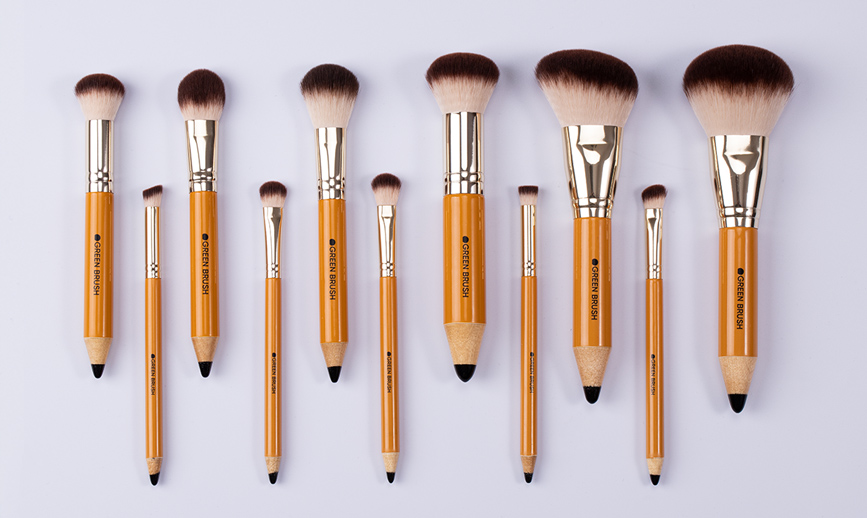
Launching a private label makeup brush is relatively straightforward when the initial order is small. The challenge becomes much greater when a brand needs to manufacture the same brush in large quantities while maintaining consistent quality, controlling costs, and ensuring reliable delivery.
Not every attractive brush design is automatically suitable for large-scale private label production.
A brush may look impressive as a prototype but become difficult to manufacture consistently when production volume increases. Complex shapes, unstable materials, excessive manual adjustments, difficult assembly steps, or inconsistent components can all create problems when thousands of units need to be produced to the same specification.
For private label brands, the most scalable makeup brush is therefore not necessarily the simplest or cheapest design. It is a design that can deliver the required appearance and performance while remaining repeatable, manufacturable, inspectable, and supply-chain friendly.
So, what makes a makeup brush suitable for large-scale private label production?
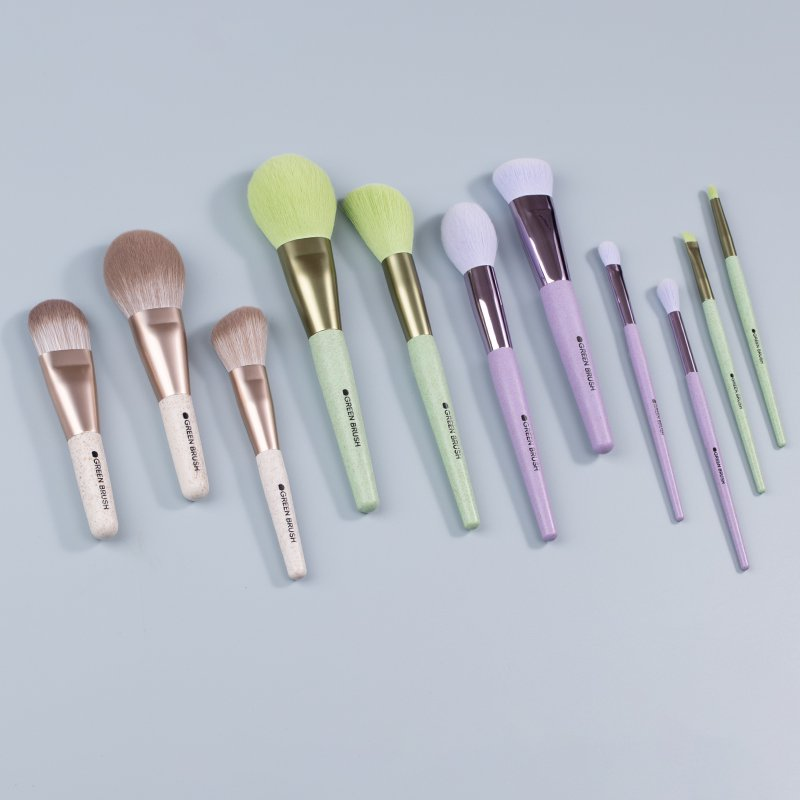
Large-scale production starts with a clear product definition.
A manufacturer needs more than a product name or reference photograph. The brush should have defined specifications for the components and characteristics that affect its appearance and performance.
These may include:
Fiber material
Fiber diameter
Fiber length
Fiber color
Fiber density
Brush-head dimensions
Head shape
Loft
Ferrule dimensions
Ferrule material
Handle material
Handle dimensions
Handle color
Logo position
Packaging requirements
The more important a characteristic is to the final product, the more precisely it should be specified.
For example, “soft synthetic bristles” may be sufficient for an early concept discussion, but it is not necessarily enough for repeatable mass production.
A production specification should define what “soft” means in the context of the actual brush and identify the physical characteristics that contribute to that result.
A successful prototype does not automatically guarantee successful mass production.
A prototype can sometimes be adjusted individually until it reaches the desired result. Large-scale production requires that result to be reproduced repeatedly.
This makes manufacturing repeatability one of the most important characteristics of a scalable private label brush.
The design should allow the manufacturer to maintain consistency in areas such as:
Brush-head shape
Fiber density
Fiber length
Ferrule position
Handle dimensions
Component alignment
Adhesive application
Surface finishing
If every production batch requires extensive manual correction, maintaining consistent quality becomes more difficult.
A production-friendly design should therefore achieve its intended appearance and performance through a controlled process rather than repeated individual adjustments.
Material selection has a direct influence on production scalability.
A private label brush may use synthetic fibers, natural hair, wood, bamboo, plastic, metal, coatings, adhesives, and other components.
For large orders, the question is not simply whether these materials can be sourced once.
The more important question is whether the required materials can be sourced consistently over repeated production cycles.
A scalable material specification should consider:
Availability
Quality consistency
Supplier reliability
Production capacity
Batch variation
Lead time
Storage requirements
Cost stability
Compatibility with the manufacturing process
For example, changing fiber characteristics between production batches can affect brush softness, density, flexibility, and product pickup.
Likewise, variations in handle materials or coatings can create visible differences between production lots.
The brush head is often the most performance-sensitive part of the product.
Its final behavior depends on several variables, including:
Fiber type
Fiber diameter
Fiber length
Fiber quantity
Density
Shape
Loft
Trimming
Forming
A brush intended for large-scale production should have a brush-head structure that can be reproduced within defined tolerances.
This does not mean every brush needs to have a simple shape.
Complex designs can also be manufactured at scale when the process, tooling, materials, and inspection standards are properly established.
The important factor is whether the complexity can be controlled.
Handle and ferrule design also affect production scalability.
A handle may involve:
Injection molding
Wood machining
Bamboo processing
Coating
Painting
Printing
Metal components
Special surface treatments
Each additional process can introduce another source of variation.
This does not mean that customized handles should be avoided.
Instead, brands should understand which features are critical to the product and establish appropriate tolerances.
The ferrule also needs consistent:
Dimensions
Position
Alignment
Surface finish
Crimping
Connection with the handle
A visually distinctive handle can still be suitable for large-scale production if its manufacturing process is sufficiently stable.
Handcrafting and large-scale production are not necessarily opposites.
Green Brush describes its manufacturing approach as combining traditional brush-making techniques with a multi-step handcrafted process, while also providing production and testing for customized products. Its site states that each brush passes through at least 30 working steps.
The important distinction is between controlled craftsmanship and uncontrolled variation.
Manual operations can remain part of a premium brush manufacturing process, but the critical steps should have clear standards.
For large-scale private label production, brands should ask:
Which steps are manual?
Which steps are standardized?
Which steps require individual adjustment?
How is operator variation controlled?
How is the finished result inspected?
The goal is not necessarily to eliminate manual work. It is to ensure that manual work produces repeatable results.
A product becomes easier to scale when its quality can be measured.
For a makeup brush, quality control may cover several categories.
Brush-head shape
Handle finish
Ferrule appearance
Logo placement
Color consistency
Surface defects
Overall brush length
Handle dimensions
Ferrule dimensions
Head dimensions
Fiber length
Alignment
Bonding
Ferrule attachment
Handle connection
Softness
Firmness
Flexibility
Product pickup
Product release
Application control
Fiber shedding
Pull strength
Bond strength
Coating durability
Washing resistance where applicable
A brush with clear inspection criteria is easier to manage across large production quantities.
No manufacturing process produces every unit at mathematically identical dimensions.
Large-scale production therefore requires acceptable tolerances.
For example, a specification might define acceptable ranges for:
Handle length
Head length
Head width
Fiber length
Ferrule position
Overall weight
Color
Logo placement
The tolerance should be based on the product's function and manufacturing capability.
Overly tight tolerances can increase manufacturing difficulty and cost without providing meaningful customer value.
Overly broad tolerances can create visible or functional differences.
The appropriate goal is a tolerance range that protects the intended product experience while remaining realistic for production.
A scalable brush should not move directly from concept to a very large production order without sufficient validation.
A structured development process can include:
Concept → Prototype → Sample refinement → Testing → Final approval → Production
The purpose of sampling is not simply to confirm that the brush looks attractive.
It is an opportunity to determine whether the design can actually be manufactured according to the intended specifications.
Testing may reveal:
Fiber-density problems
Shape instability
Bonding problems
Handle defects
Ferrule alignment issues
Excessive shedding
Application-performance differences
Green Brush describes its custom process as including design, sample customization, production, and testing before products move forward.
Large-scale private label production is also a supply-chain challenge.
Even if a manufacturer can technically produce the brush, the product may become difficult to scale if critical components have unstable supply.
Brands should consider:
Raw-material availability
Component suppliers
Production capacity
Lead times
Packaging supply
Shipping requirements
Backup sourcing where appropriate
A product with an unusual component that is difficult to replenish may create supply problems when demand increases.
For this reason, scalable product development should consider sourcing at the same time as design.
Packaging is often considered separately from the brush itself, but it can influence the scalability of the entire private label program.
Packaging should be evaluated for:
Component availability
Assembly complexity
Protection during transportation
Storage efficiency
Shipping dimensions
Labeling requirements
Retail presentation
A complicated package can add substantial labor and logistics requirements when order quantities increase.
Green Brush states that its private label services can include logo imprinting, packaging design, gift sets, and integrated logistics support.
For brands planning large distribution volumes, packaging should therefore be developed together with the brush rather than treated as an afterthought.
A large-scale private label brush still needs to match the commercial strategy of the brand.
The right design depends on factors such as:
Retail price
Target customer
Distribution channel
Product positioning
Expected sales volume
Packaging requirements
Desired product lifespan
For example, a brush designed for a mass-market retail program may prioritize efficient manufacturing, stable materials, and packaging efficiency.
A premium collection may place greater emphasis on specialized materials, distinctive handles, finishing, and tactile experience.
Both can potentially be produced at scale, but the manufacturing strategy will be different.
Scalability becomes more efficient when several brushes in a collection share components or manufacturing principles.
A brand might standardize:
Handle materials
Handle colors
Ferrule finishes
Logo treatment
Packaging components
Fiber families
Manufacturing methods
This can simplify purchasing and production planning.
For example, a collection could use several brush-head shapes while maintaining the same handle material and ferrule finish.
That creates product differentiation without requiring an entirely different component system for every SKU.
Green Brush currently offers multiple face, eye, lip, and brush-set categories as well as customized handles, ferrules, bristles, and packaging.
Customization is valuable for private label brands, but every new component can introduce additional manufacturing requirements.
A brand may be able to differentiate its brush through:
Fiber selection
Brush-head geometry
Handle shape
Color
Ferrule finish
Logo
Packaging
Not every element needs to be completely unique.
Using proven components where appropriate can reduce development complexity while still allowing meaningful brand differentiation.
This is particularly useful when a company plans to launch multiple SKUs or scale the collection over time.
Large-scale production may continue for months or years.
During that period, suppliers, materials, equipment, and processes can change.
A scalable private label program should therefore establish rules for handling changes.
Before changing a critical component, the manufacturer and brand should determine:
What is changing?
Why is it changing?
Does the new material perform equivalently?
Is a new sample required?
Does the change affect cost?
Does it affect appearance?
Does it affect performance?
Does it require customer approval?
This helps prevent a brush from gradually changing while retaining the same product name and SKU.
A brush that performs well in the first production run should continue to perform similarly in later runs.
This requires more than a one-time approval.
Important batch characteristics can be tracked over time, including:
Dimensions
Weight
Fiber characteristics
Appearance
Defect rates
Shedding
Bond strength
Customer feedback
Monitoring production trends can help identify gradual process drift before it becomes a larger commercial problem.
This is especially important for private label brands that expect repeat orders.
A manufacturer should be able to support the expected order volume without compromising quality.
Green Brush states that it accommodates both small-batch and large-scale orders and describes its production capacity and quality-control processes as supporting larger orders.
For a brand evaluating production readiness, capacity should be considered together with:
Current order volume
Expected growth
Number of SKUs
Production lead time
Component availability
Quality-control capacity
Packaging capacity
Shipping requirements
A supplier's nominal production capacity is only one part of the equation. The relevant question is whether the manufacturer can maintain the required quality and delivery performance at the brand's expected scale.
Before moving a private label brush into large-scale production, brands can review the following checklist:
| Area | Key Question |
|---|---|
| Design | Can the brush be manufactured repeatedly to the same specification? |
| Materials | Are critical materials stable and consistently available? |
| Brush head | Can density, shape, and dimensions be controlled? |
| Handle | Are dimensions, color, and finish repeatable? |
| Ferrule | Can alignment and assembly be standardized? |
| Performance | Are the required application characteristics clearly defined? |
| Quality | Are inspection methods and acceptance criteria established? |
| Tolerances | Are acceptable dimensional and cosmetic ranges documented? |
| Sampling | Has the production process been validated before scale-up? |
| Supply chain | Can materials and components support repeat orders? |
| Packaging | Can packaging be produced, assembled, stored, and shipped efficiently? |
| Change control | Are material and process changes formally reviewed? |
| Capacity | Can the supplier support expected order volume and future growth? |
| Consistency | Can later batches match the approved product? |
A makeup brush suitable for large-scale private label production is not defined simply by its appearance or by how attractive the prototype looks.
It needs to combine product performance with manufacturing repeatability.
The most important factors include:
Clearly defined specifications
Stable raw materials
Repeatable brush-head construction
Controlled handle and ferrule manufacturing
Practical manufacturing tolerances
Measurable quality standards
Reliable testing
Stable component supply
Efficient packaging
Formal change control
Consistent production across batches
Sufficient manufacturing capacity
For a growing beauty brand, these factors should be considered before large-scale production begins.
The best time to evaluate scalability is during product development—not after the first major production order has already been placed.
A well-designed private label makeup brush should therefore be evaluated from two perspectives at the same time:
Can consumers experience the performance and design the brand wants?
and
Can the manufacturer reproduce that experience consistently at commercial volume?
When both answers are built into the product from the beginning, scaling a private label makeup brush collection becomes a much more controlled manufacturing process.
Previous: None
Next: Why the Second Makeup Brush Order Is Different: How to Keep Reorders Consistent
Leave a Message